How to Get Your Business Recommended by ChatGPT
What AI assistants rely on when they suggest a local business, and how to give yours the best chance.
- ChatGPT can search the web and cite sources when answering local questions.
- It can only recommend what it can find and understand about your business.
- Consistent business details, clear website content, reviews and mentions all help.
- No one can guarantee a ChatGPT recommendation, but you can improve your odds.
More customers now ask ChatGPT questions like “who’s a reliable electrician near me?” or “best dentist in Dallas for implants”. If your business isn’t part of the answer, that customer may never find you. This guide explains how AI assistants put together local recommendations and what you can do to improve your chances.
How ChatGPT answers local questions
ChatGPT can search the web when a question needs current information, then summarize what it finds and link to sources. For local questions, that means its answer is built from information that already exists online: business websites, review sites, directories, maps data, news and other pages.
In other words, ChatGPT doesn’t have a private list of good businesses. It recommends what it can find, understand and trust.
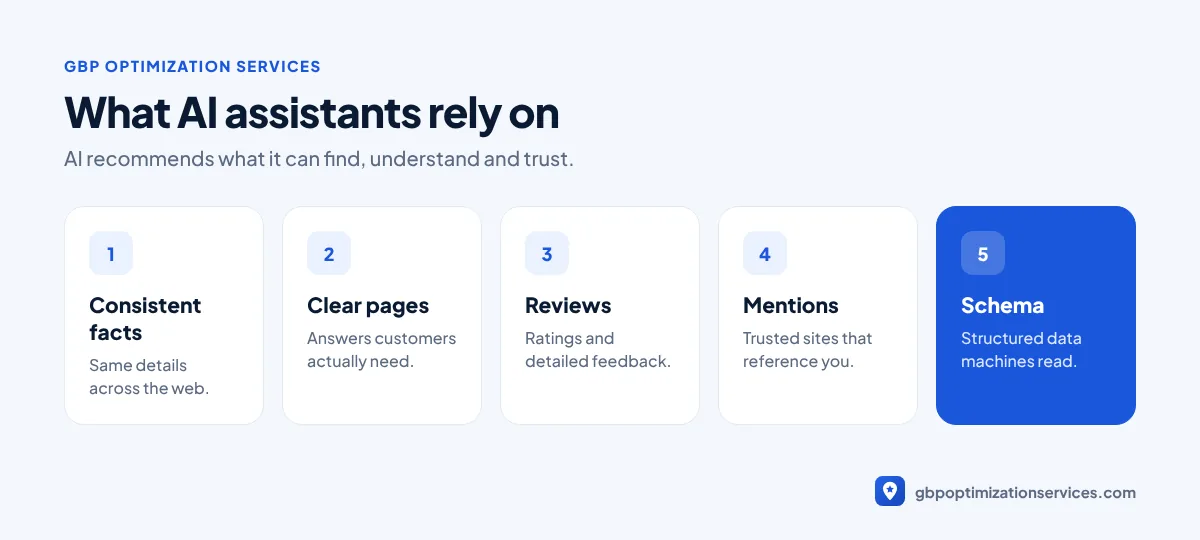
What makes a business easy to recommend
| Signal | Why it matters to AI |
|---|---|
| Consistent business details | Same name, address, phone and services everywhere reduces confusion |
| Clear service pages | Plain-language answers are easy to summarize and quote |
| Reviews on major platforms | Ratings and review content signal quality and specialties |
| Mentions on trusted sites | Local news, associations and directories add credibility |
| Structured data | Schema helps machines read your facts accurately |
| A complete Google Business Profile | A major source of local business information |
Step 1: Make your facts consistent everywhere
Check your business name, address, phone number, hours and services on your website, Google Business Profile, Bing Places, Apple Business Connect, Yelp and the main directories in your industry. Fix anything that doesn’t match. Inconsistent details make it harder for any system to describe you confidently.
Step 2: Write pages that answer real questions
AI assistants summarize content. Pages that clearly answer the questions customers ask are much easier to use than vague marketing copy.
- One page per main service, explaining what it is, who it’s for, the area you cover and typical pricing information if you share it.
- An FAQ section with the questions customers actually ask on the phone.
- Clear headings and short paragraphs.
Step 3: Earn detailed reviews
When people ask for “the best” or “the most trusted” option, ratings and what reviews say matter a lot. Encourage customers to mention the specific service and location in their review. See our guide on getting more Google reviews for a compliant system.

Get a free Google Business Profile audit, reviewed personally by Arbaz. Usually within 24 hours.
Step 4: Get mentioned beyond your own website
Mentions on other trusted sites act like references. Useful places include local news, chambers of commerce and trade associations, supplier and partner websites, industry directories, and community or sponsorship pages. Our guide on how AI Overviews choose local businesses explains why this kind of authority matters for AI answers.
Step 5: Add structured data
LocalBusiness schema on your website states your name, address, phone, hours and services in a format machines read easily. FAQ schema can mark up your questions and answers. Neither guarantees anything, but both reduce ambiguity.
Step 6: Test and track
- Ask ChatGPT the questions your customers ask, in the way they’d ask them.
- Note which businesses are recommended and which sources are cited.
- Compare those businesses with yours: reviews, content and mentions.
- Repeat monthly, because answers change over time.
What not to do
- Don’t create fake reviews or fake listings to influence AI answers.
- Don’t stuff pages with keywords. Clear writing works better.
- Don’t expect overnight results. AI visibility builds on the same foundations as local SEO.
What a “recommendable” business page looks like
Here’s a simple structure for a service page that AI assistants can easily understand and quote:
- A clear headline: the service and area, such as “Emergency Electrician in Denver”.
- A one-paragraph summary: what you do, who for, response times and the area you cover.
- What’s included: a short list of services or steps.
- Pricing guidance: typical ranges or how pricing works, if you share it.
- Proof: reviews, photos or short case examples.
- FAQs: five to eight real questions with direct answers.
- Contact details: name, phone and address or service area, matching your profile.
Signals to check against competitors
| Signal | Your business | Top recommended competitor |
|---|---|---|
| Google rating and review count | ||
| Reviews mentioning the specific service | ||
| Dedicated service page | ||
| Mentions on local or industry sites | ||
| Consistent details across directories |
Fill this in after running your test prompts. The gaps show exactly where to focus next.
Common mistakes
- Trying to game the answer. Focus on real reputation and clear information.
Can anyone guarantee ChatGPT will recommend you?
No. Answers vary by user, wording, location and time. What you can control is how clear, consistent and well-regarded your business looks across the web. That’s the focus of our AI search optimization service, built on strong local SEO.
Frequently asked questions
ChatGPT draws on information it can find on the web, which can include review sites. Strong ratings across major platforms help.
It builds on SEO. Accurate business data, helpful content, reviews and mentions support both search engines and AI assistants.
There’s no set timeline. Improvements to your content and reputation are picked up as AI systems search and read the web over time.
There’s no way to buy a place in ChatGPT’s organic recommendations. Be wary of anyone who claims otherwise.
If information about your business is available and consistent online, AI assistants can find it when they search. Check by asking customer-style questions.
No. A clear, well-structured website serves customers, search engines and AI assistants together.
It depends on the sources its search uses at the time. Strong reviews across platforms help.
Arbaz Shaukat
Arbaz has spent more than 7 years ranking local businesses on Google Maps, and now in AI search. He built and refined his own Google Business Profile strategies across industries such as home services, transport and healthcare, and personally plans every client project. Results from his work include 54 to 686 Google clicks in three months and a 150% increase in calls for a private taxi service.
Ready to be the business customers pick first?
Get a free GBP audit, reviewed personally, usually within 24 hours.