How to Expand from Local SEO to National SEO
You have conquered your local market. When people search for your services in your city, you show up at the top. But now, you are hitting a ceiling. You want more customers, more reach, and bigger growth.
It is time to look beyond your city limits.
Moving from a local focus to a national audience is a big leap. It requires a different mindset and a new set of tactics. You stop fighting for “plumber in Chicago” and start fighting for “best plumbing tips” or “emergency plumbing services” across the country.
This guide is your practical roadmap. We will show you exactly how to expand from local SEO to national SEO without losing the local rankings you worked so hard to build.
What is Local SEO vs National SEO (Quick Comparison)
Before you start changing your website, you need to understand the battlefield.
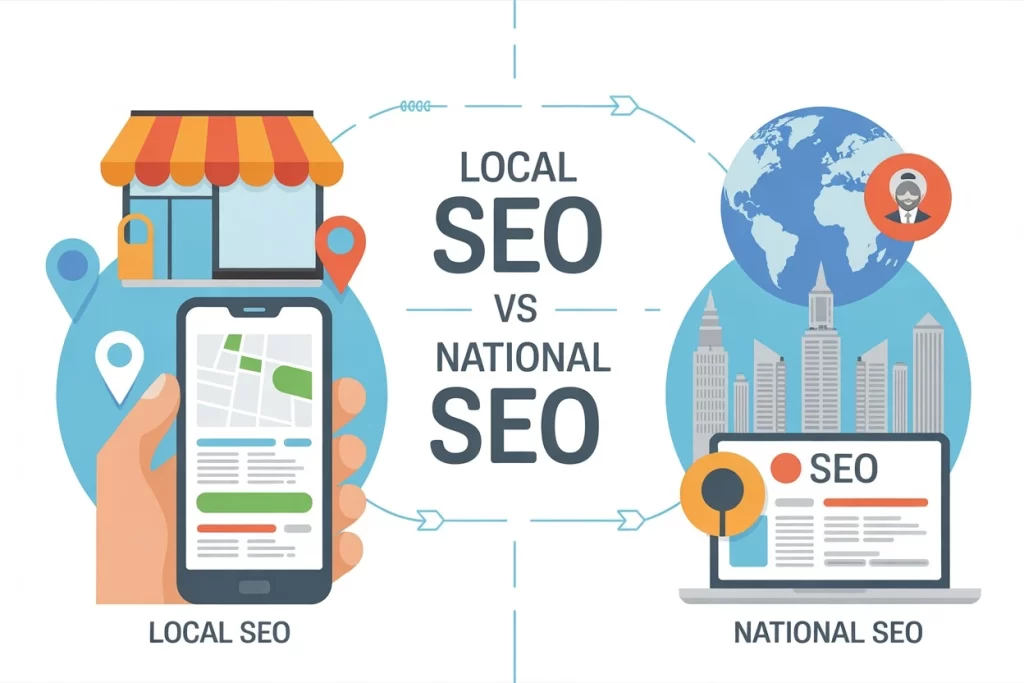
Local SEO is about being a big fish in a small pond. You target customers in a specific geographic area. Google uses your physical location (IP address and GPS) to show results.
National SEO is about swimming in the ocean. You target intent, not location. You are competing with the biggest brands in your industry for broad terms.
Here is a quick breakdown of local vs national SEO:
| Feature | Local SEO | National SEO |
|---|---|---|
| Primary Goal | Drive foot traffic or local calls | Drive national traffic and sales |
| Keywords | Geo-modified (e.g., “Chicago Dentist”) | Broad intent (e.g., “Teeth Whitening Kit”) |
| Competition | Low to Medium (Other local shops) | High to Very High (Major brands) |
| Trust Signals | Google Business Profile, Local Reviews | Domain Authority, High-quality Backlinks |
| Content Focus | Local news, events, location pages | Educational guides, product pages, blogs |
When Your Business Is Ready to Go National
Not every business should go national. Scaling too early can drain your budget and hurt your local rankings.
You are ready to launch a national SEO strategy if:
- You can serve everyone: You have the logistics to ship products nationwide or offer digital services (like consulting or software) to anyone.
- You have the budget: National keywords are more competitive. You will need more resources for content and links.
- You have maxed out local: You already rank #1 for your top local terms and simply cannot squeeze more traffic out of your city.
- Your site is strong: You have a solid domain authority and a technical foundation that can handle more pages and traffic.
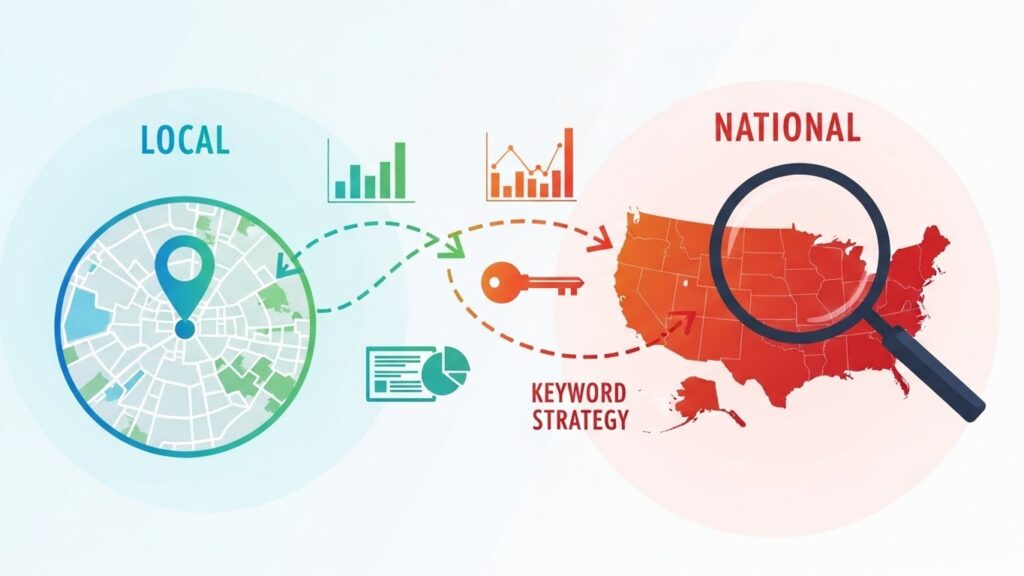
Keyword Strategy Shift (Local → National)
This is the biggest change you will make. In local SEO, you rely on “Service + City” keywords. In national SEO, those city names disappear.
1. Drop the Geo-Modifiers
Instead of targeting “SEO Agency Atlanta,” you shift to “SaaS SEO Agency” or “Enterprise SEO Services.” You are now targeting the problem the user has, not where they live.
2. Target “Problem-Aware” Keywords
National audiences often search for information before they buy.
- Local: “Buy running shoes near me”
- National: “Best running shoes for flat feet” or “How to train for a marathon”
3. Look for Long-Tail Opportunities
Do not try to rank for single words like “Shoes” or “Lawyer” immediately. You will get crushed by giants like Amazon or Wikipedia. Start with long-tail keywords (3-4 word phrases) that have decent volume but lower difficulty. This is essential for scaling SEO effectively.
Site Structure & Scalable Content Planning
Your website structure is like the foundation of a house. If you build a skyscraper on a cottage foundation, it will collapse.
For national SEO, you need a “Silo Structure.” This means grouping related content together so Google understands your expertise.
Example Structure:
- Homepage
- Main Service/Product Category (Parent Page)
- Sub-service page
- Sub-service page
- Related Blog Post
- Related Blog Post
- Main Service/Product Category (Parent Page)
This hierarchy helps link equity (ranking power) flow from your strong pages to your new, deeper pages. It also helps users navigate your site easily.
Also Read How Local SEO Increases Your Revenue and Grows Your Business.
Content Expansion (Blogs, Pillar Pages, Programmatic SEO)
To compete nationally, you need content. A lot of it. You cannot just have 5 service pages and expect to rank nationwide.
Pillar Pages
Create comprehensive guides that cover a broad topic in depth. A pillar page acts as a hub. For example, a “Ultimate Guide to Kitchen Remodeling” could link out to smaller articles about cabinets, flooring, and lighting.
Blogs that Solve Problems
Write articles that answer the “People Also Ask” questions you see in search results. If you sell coffee, don’t just write about your beans. Write about:
- “How to brew French press coffee”
- “Difference between Arabica and Robusta”
- “Best coffee grinders for home use”
Programmatic SEO (For Large Scale)
If you have a massive inventory or data set, you might use programmatic SEO. This involves creating thousands of pages automatically based on templates. For example, a travel site might generate pages for “Best Hotels in [City Name]” for every city in the US. Note: Only do this if you can ensure high quality for every page.
Internal Linking for National Authority
Internal linking is your secret weapon. It connects your old, powerful local pages to your new national content.
- Link Up: Link from detailed blog posts back to your main product or service pages. This tells Google, “This product is important.”
- Link Across: Link related blog posts to each other.
- Use Descriptive Anchor Text: Don’t use “click here.” Use “read our guide on national SEO strategy.”
Pro Tip: If you have a local page that has tons of backlinks, find a way to naturally link from that page to your new national pillar page. This passes authority instantly.
Link Building at a National Level
Local link building relies on the Chamber of Commerce and local directories. National link building is harder. You need links from high-authority websites relevant to your industry.
Strategies that work:
- Digital PR: Create interesting data studies or surveys and pitch them to journalists. If you are a finance company, release a study on “How inflation affects savings.”
- Guest Posting: Write high-quality articles for other reputable blogs in your niche.
- Resource Page Link Building: Find pages that list “Best Tools for X” and ask to be included.
Technical SEO Considerations
As your site grows from 20 pages to 200 (or 2,000), technical errors can multiply.
- Crawl Budget: Google has a limit on how many pages it crawls on your site. Don’t waste it on duplicate pages or low-quality tags.
- Site Speed (Core Web Vitals): National users have less patience. If your site is slow, they will bounce to a competitor. Ensure your LCP (Largest Contentful Paint) is under 2.5 seconds.
- Mobile Friendliness: Most national traffic will likely come from mobile devices. Test every new page template on your phone.
Tracking & KPIs (Rankings, Traffic, Conversions)
How do you know if you are winning? You need to track the right metrics.
Rankings: Track your main keywords. You will likely see volatility (ups and downs) when you first expand.
Organic Traffic: Look for steady growth in “Users” and “Sessions” from outside your local area.
Conversions: Traffic is vanity; revenue is sanity. Are these national visitors actually buying or filling out forms?
Click-Through Rate (CTR): Are people clicking your title in search results? If not, rewrite your titles to be more catchy.
Check out Top 7 Google Maps Rank Checker Tools.
Common Mistakes When Scaling Too Fast
We see business owners make these mistakes time and time again.
- Cannibalization: This happens when your new national page competes with your old local page for the same keyword. Google gets confused and ranks neither. Keep your local pages focused strictly on the location (e.g., “Chicago”).
- Neglecting Local SEO: Do not let your local rankings die while chasing national glory. Local leads are often easier to convert.
- Generic Content: Writing 500-word blog posts that say the same thing as everyone else won’t work. You must add unique value or data.
Local + National SEO: How to Run Both Together
Can you do both? Absolutely. This is often called a hybrid approach or multi-location SEO strategy.
- Keep Location Pages: Keep your specific “Service + City” pages. They are your safety net.
- Build a National Blog: Use your blog folder (/blog) to target national, informational keywords.
- Use Hreflang Tags (If Global): If you are going international, use language tags. For US-only national expansion, focus on site structure.
- Google Business Profile: Keep your profile active for local searches, even as your website targets the nation.
How long does it take to see results?
Patience is key.
- Local SEO changes often show results in 3–4 months.
- National SEO takes longer—typically 6 to 12 months to see significant traction.
You are entering a bigger league. It takes time for Google to trust that you are an authority on a national level, not just a local expert.
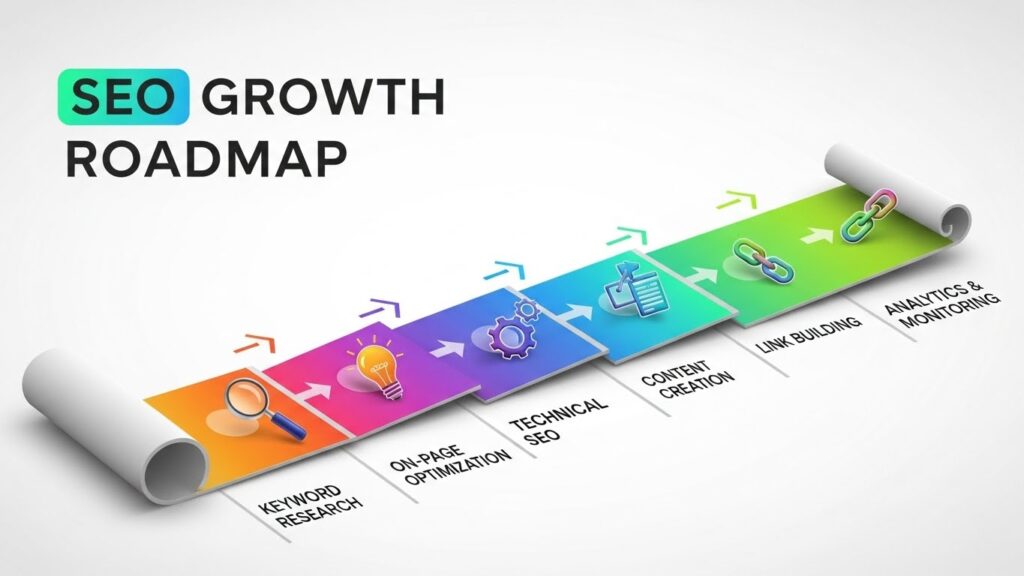
Your Expansion Checklist (SEO Growth Roadmap)
Use this checklist to ensure you cover all bases as you expand from local SEO to national SEO.
- Audit: Perform a full technical audit of your current site.
- Competitors: Analyze top 3 national competitors (not just local ones).
- Keywords: Build a list of non-geo-modified, high-intent keywords.
- Structure: Map out new site hierarchy and “silos.”
- Content: Create a content calendar for the next 6 months.
- On-Page: Optimize title tags and headers to remove city names on national pages.
- Local Protection: Ensure existing local pages are distinct and preserved.
- Link Building: Launch a Digital PR or outreach campaign.
- Tracking: Set up advanced tracking in Google Analytics 4 (GA4).
Ready to Conquer the National Market?
Expanding your reach is exciting, but it is easy to get lost in the technical details. You don’t have to navigate this growth alone.
If you are serious about scaling your revenue and need a proven partner to handle the strategy, let’s talk. We help successful local businesses become national brands.
Contact Us Today for a Free SEO Consultation.

Arbaz Shaukat is a Local SEO Expert who helps websites generate more leads, traffic, and sales from Google and AI-driven search platforms like ChatGPT through proven SEO strategies. He is the Founder of GBP Optimization Services, where he works closely with businesses to improve their online visibility on the internet.
Since 2020, Arbaz has been active in SEO and loves to share experience-based blog content offering practical insights, tested SEO techniques, and real-world strategies that help businesses grow and compete effectively online.