Ahrefs vs SEMrush vs Moz – Which Tool is Best in 2026
Search Engine Optimization (SEO) is a fundamental part of growing a business online. To do it effectively, you need data. SEO tools provide this data, helping you understand your website, your competitors, and your customers. But with so many options available, choosing the right one can feel overwhelming. Picking a tool that doesn’t fit your goals can lead to wasted money and missed opportunities.
This guide provides an in-depth SEO tools comparison of the three biggest names in the industry: Ahrefs, SEMrush, and Moz. We will explore their features, strengths, and weaknesses to help you decide which platform is the best SEO tool in 2026 for your specific needs. Whether you’re a business owner, a seasoned SEO professional, or just starting, this comparison will give you the clarity to make an informed decision.
Understanding SEO Tools Before Comparing Them
Before we dive into the specifics of Ahrefs vs SEMrush vs Moz, it’s important to understand what these platforms do and, more importantly, what they don’t do. They are powerful allies in your SEO efforts, but they are not magic wands.
What SEO Tools Are Used For
At their core, SEO tools are data platforms. They crawl the web, gather massive amounts of information, and present it in a way that helps you make better marketing decisions. Their primary functions include:
- Keyword Research: Finding the terms people use to search for your products or services.
- Backlink Analysis: Seeing which websites link to you and your competitors.
- Rank Tracking: Monitoring your website’s position on Google for target keywords.
- Site Audits: Identifying technical issues that could be hurting your rankings.
- Competitor Analysis: Spying on what’s working for other sites in your industry.
Keyword Research vs Competitive Research
While related, these are two different activities. Keyword research is about finding opportunities—what new terms can you rank for? Competitive research is about analysis—what are your competitors already ranking for, and how are they doing it? A good SEO tool excels at both, allowing you to find new keywords and deconstruct your competitors’ successful strategies.
On-Page SEO, Technical SEO & Off-Page SEO
SEO can be broken down into three main categories. SEO tools help with all of them:
On-Page SEO: Optimizing the content on your web pages (e.g., using the right keywords, writing good titles). Tools help you find keywords and analyze top-ranking content.
Technical SEO: Ensuring your website is easy for search engines to crawl and index. Site audit features in these tools are built for this.
Off-Page SEO: Building authority through actions taken outside your website, primarily by earning backlinks. Backlink analysis tools are essential for this.
SEO Tools vs Real SEO Strategy
This is a critical distinction. An SEO tool provides data. An SEO strategy is how you interpret that data and turn it into action. A tool can tell you that a competitor has 100 backlinks, but it can’t build those links for you. It can tell you a keyword has 1,000 monthly searches, but it can’t write the high-quality content needed to rank for it. Your success depends on your ability to connect the data to a smart, actionable plan.
What Is Ahrefs?
Ahrefs started as a backlink analysis tool and quickly became famous for having one of the largest and most accurate backlink indexes on the market. Over the years, it has evolved into a comprehensive, all-in-one SEO suite trusted by professionals worldwide for its powerful data and intuitive interface.
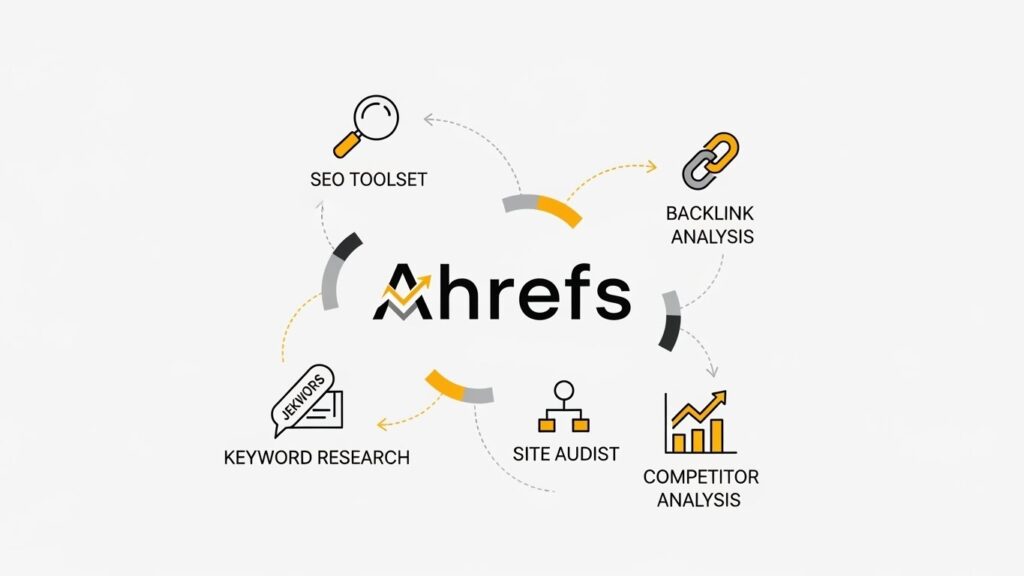
Core Features of Ahrefs
Site Explorer: A deep dive into any website’s backlink profile, organic traffic, and paid keywords.
Keywords Explorer: An advanced keyword research tool with excellent filtering and data on search volume, keyword difficulty, and clicks.
Site Audit: A technical SEO tool that crawls your website to find and report on over 100 common SEO issues.
Rank Tracker: Monitors your keyword rankings across different countries and devices, providing daily updates.
Content Explorer: A searchable database of billions of web pages to find content ideas and link opportunities.
Strengths of Ahrefs
Superior Backlink Data: Ahrefs is widely considered the industry leader for backlink analysis. Its crawler is second only to Google’s in size and speed, providing the most comprehensive and fresh link data.
User-Friendly Interface: Despite its powerful features, Ahrefs is incredibly intuitive. Data is presented in clean, easy-to-understand charts and graphs, making it accessible even for beginners.
Excellent Keyword Data: Keywords Explorer provides not just search volume but also “clicks” data, which tells you how many people actually click on search results for a given keyword. This is invaluable for identifying truly valuable terms.
Innovation: Ahrefs constantly releases new features and improves existing ones, often setting the standard for the industry.
Limitations of Ahrefs
Higher Price Point: Ahrefs’ pricing, especially for its entry-level plans, can be a barrier for freelancers or small businesses.
Limited On-Page Content Tools: Compared to SEMrush, Ahrefs offers fewer tools specifically for content creation and on-page optimization guidance.
No Full PPC/Social Media Suite: Ahrefs is laser-focused on SEO. It has some PPC data but lacks the comprehensive social media and content marketing tools found in SEMrush.
Best Use Cases (Who Should Use Ahrefs?)
Ahrefs is the go-to tool for anyone whose strategy relies heavily on link building and competitor backlink analysis. It’s ideal for:
- SEO professionals and agencies.
- Content creators and bloggers focused on organic traffic.
- Businesses in competitive niches where backlinks are a primary ranking factor.
What Is SEMrush?
SEMrush positions itself as an “all-in-one marketing toolkit.” It started with a strong focus on competitive research and keyword data but has expanded dramatically to cover almost every aspect of digital marketing, including SEO, PPC, social media, and content marketing.
Core Features of SEMrush
Keyword Magic Tool: A massive database of keywords with powerful grouping and filtering capabilities.
Domain Overview: A quick snapshot of a website’s authority, organic traffic, paid traffic, and backlinks.
SEO Writing Assistant: A real-time content optimization tool (via a Google Docs add-on) that helps you write SEO-friendly content.
Position Tracking: A robust rank tracker with features for monitoring local rankings and SERP feature volatility.
Link Building Tool: A CRM-style tool to manage outreach campaigns for building backlinks.
Comprehensive Advertising and Social Media Toolkits: Tools for analyzing ad copy, managing social media posting, and more.
Strengths of SEMrush
All-in-One Solution: SEMrush’s biggest strength is its breadth. It provides solid tools for nearly every digital marketing discipline, making it a great value for teams that need more than just SEO data.
Powerful Keyword and Competitive Research: The SEMrush vs Ahrefs debate often centers here. SEMrush has a massive keyword database and excels at showing you exactly what your competitors are doing across both organic and paid search.
Strong On-Page and Content Tools: Features like the SEO Writing Assistant give users actionable advice for improving their content, bridging the gap between data and execution.
Market Research Features: Tools like “Market Explorer” provide high-level insights into industry trends and competitor market share.
Limitations of SEMrush
Complex Interface: With so many tools, the user interface can feel cluttered and overwhelming for new users. There is a steeper learning curve compared to Ahrefs.
Backlink Index Can Lag: While its backlink data has improved significantly, it is still generally considered less comprehensive and slightly slower to update than Ahrefs’.
Credit System Can Be Confusing: Some reports and features use a credit system, which can be confusing and lead to unexpected costs on top of the monthly subscription.
Best Use Cases (Who Should Use SEMrush?)
SEMrush is perfect for marketers and businesses who need a single platform to manage multiple aspects of their online presence. It’s best for:
- Full-service digital marketing agencies.
- In-house marketing teams managing SEO, PPC, and social media.
- Businesses that rely heavily on paid advertising alongside SEO.
What Is Moz?
Moz is one of the original players in the SEO software space. It is well-known for its educational content and for popularizing metrics like Domain Authority (DA). Moz Pro offers a suite of SEO tools focused on providing actionable insights with a strong emphasis on education and community.
Core Features of Moz
Keyword Explorer: A keyword research tool that provides search volume, difficulty, and a “Priority” score to help you choose the best targets.
Link Explorer: A backlink analysis tool powered by its own large link index.
Site Crawl: A technical SEO audit tool that finds issues and recommends fixes.
Rank Tracker: Tracks keyword rankings over time on major search engines.
Moz Local: A separate product focused on managing and optimizing local business listings.
Strengths of Moz
User-Friendly and Educational: Moz excels at making complex SEO data understandable. Its interface is clean, and tools like “Keyword Priority” help beginners make smarter decisions.
Strong Local SEO Focus: Through its Moz Local product, it offers one of the best solutions on the market for managing local business listings and citations.
Domain Authority (DA): While it’s just a third-party metric, DA is a widely recognized industry standard for quickly gauging a website’s authority.
Great Community and Support: Moz has a long history of fostering a strong community through its blog and Q&A forum, providing excellent learning resources.
Limitations of Moz
Smaller and Slower Data Indexes: In the Moz vs SEMrush and Ahrefs comparison, Moz’s backlink and keyword databases are generally smaller and updated less frequently. This can lead to missed opportunities.
Slower Innovation: Moz has been slower to release new, groundbreaking features compared to its more agile competitors.
Core Tools Less Robust: While user-friendly, the core features for keyword research and link analysis lack the depth and advanced filtering options found in Ahrefs and SEMrush.
Best Use Cases (Who Should Use Moz?)
Moz is an excellent choice for those new to SEO or businesses with a strong focus on local search. It’s best for:
- SEO beginners and students.
- Small business owners managing their own SEO.
- Businesses that need to manage multiple physical locations (with Moz Local).
Ahrefs vs SEMrush vs Moz – Detailed Comparison
Let’s break down how these three tools stack up against each other in the most critical areas of SEO.
Keyword Research Accuracy
Ahrefs: Excellent. Provides unique “clicks” data and has very reliable keyword difficulty scores. Its database is massive and regularly updated.
SEMrush: Excellent. Its Keyword Magic Tool is arguably the best for brainstorming and discovering related long-tail keywords. The database size is comparable to Ahrefs.
Moz: Good. The keyword data is solid, and the “Priority” score is helpful for beginners. However, its database is smaller, so it may miss some lower-volume or newer keywords.
- Winner: Tie between Ahrefs and SEMrush.
Backlink Analysis & Link Data
Ahrefs: The Gold Standard. Has the largest, fastest, and most up-to-date backlink index. Its reports on new, lost, and broken links are second to none.
SEMrush: Very Good. Has made huge improvements and is now a strong competitor. However, it still occasionally misses links that Ahrefs finds and can be slower to report them.
Moz: Good. Its Link Explorer is useful, but its index is significantly smaller and slower to update than both Ahrefs and SEMrush.
- Winner: Ahrefs.
Competitive Research
Ahrefs: Excellent. Site Explorer makes it easy to see a competitor’s top pages, keywords, and backlink strategy.
SEMrush: Excellent. This is SEMrush’s home turf. It provides deep insights into a competitor’s organic traffic, paid ads, display ads, and even social media promotion.
Moz: Good. You can analyze competitors, but the data is less comprehensive, providing more of a high-level overview.
Winner: SEMrush, due to its broader scope across paid and organic channels.
Rank Tracking
Ahrefs: Very Good. Provides reliable daily updates, SERP feature tracking, and competitor comparisons.
SEMrush: Excellent. Offers more granular options, including tracking for specific geographic locations (down to ZIP code) and device types. Its volatility score is a unique and helpful feature.
Moz: Good. Provides reliable tracking but with fewer advanced features and less frequent updates on some plans.
- Winner: SEMrush.
Site Audits & Technical SEO
Ahrefs: Excellent. Its site audit tool is fast, comprehensive, and provides clear explanations and recommendations for fixing issues.
SEMrush: Excellent. Its site audit is equally powerful and integrates well with its other tools, allowing you to send identified tasks to project management platforms like Trello.
Moz: Good. The site crawl feature is effective at finding common issues but is less comprehensive than its competitors.
- Winner: Tie between Ahrefs and SEMrush.
User Interface & Learning Curve
Ahrefs: Excellent. Clean, modern, and intuitive. Most users can find what they need without extensive training.
SEMrush: Good. Powerful but can be overwhelming. The sheer number of tools and reports creates a steeper learning curve.
Moz: Excellent. Designed for clarity and ease of use. It is the most beginner-friendly of the three.
- Winner: Ahrefs for its balance of power and simplicity. Moz for absolute beginners.
Data Freshness & Accuracy
Ahrefs: Excellent. Known for having the fastest crawlers, meaning its backlink and keyword data is exceptionally fresh.
SEMrush: Very Good. Data is generally fresh and accurate, but its backlink index can have a slight delay compared to Ahrefs.
Moz: Good. The data is reliable, but its indexes are updated less frequently, which can be a drawback in fast-moving industries.
- Winner: Ahrefs.
Pricing & Value for Money
Ahrefs: Fair. Its plans are expensive, but you get best-in-class data for what you pay for. The value is high for users who need top-tier link data.
SEMrush: Very Good. While similarly priced to Ahrefs, it offers a much broader set of tools (PPC, social media), providing excellent value for a full-stack marketer.
Moz: Good. Its plans are slightly cheaper, but the data and features are less robust. Moz Local is a separate cost.
- Winner: SEMrush for the “all-in-one” value proposition.
| Feature | Ahrefs | SEMrush | Moz |
|---|---|---|---|
| Backlink Data | Excellent | Very Good | Good |
| Keyword Research | Excellent | Excellent | Good |
| Technical SEO Audit | Excellent | Excellent | Good |
| Rank Tracking | Very Good | Excellent | Good |
| User Interface | Excellent | Good | Excellent |
| Best For | Link Building | All-in-One Marketing | Beginners & Local SEO |
Which SEO Tool Is Best for Different Needs?
The best SEO tool in 2026 is the one that best matches your goals, budget, and expertise.
Best SEO Tool for Beginners
Moz is the clear winner here. Its focus on education, its clean interface, and its helpful metrics like “Keyword Priority” are designed to guide newcomers through the complexities of SEO.
Best SEO Tool for Agencies
SEMrush is often preferred by agencies. Its ability to manage SEO, PPC, and social media campaigns within one platform, combined with its client reporting and project management features, makes it an efficient all-in-one solution. Ahrefs is a very close second, especially for SEO-focused agencies.
Best SEO Tool for Bloggers & Niche Sites
Ahrefs is ideal for bloggers and niche site owners. Success in this area often depends on creating great content and building high-quality backlinks. Ahrefs’ superior link data and content analysis tools give bloggers a competitive edge.
Best SEO Tool for Local SEO & GBP Optimization
Moz Pro combined with Moz Local is the strongest offering for local businesses. While all three tools have some local SEO capabilities, Moz’s dedicated local listing management is a significant advantage. SEMrush’s local rank tracking is also very powerful.
Best SEO Tool for Enterprise SEO
SEMrush or Ahrefs (on higher-tier plans) are both suitable for enterprise needs. SEMrush’s market research tools can provide valuable high-level insights, while Ahrefs’ API and extensive data are perfect for large-scale analysis. The choice often depends on whether the enterprise needs a broader marketing toolkit (SEMrush) or best-in-class SEO data (Ahrefs).
Common SEO Tool Mistakes Professionals Make
Even with the best tools, it’s easy to make mistakes. Avoid these common pitfalls:
Relying Only on Metrics: Metrics like Domain Authority (DA) or Domain Rating (DR) are guides, not gospel. Don’t obsess over them. Focus on real-world factors like relevance and traffic.
Ignoring Search Intent: A tool can give you a keyword, but it can’t tell you why someone is searching for it. Always analyze the search results page (SERP) to understand the intent behind a query.
Tool Hopping Without Strategy: Jumping between tools looking for the “best” data is a waste of time. Pick one, learn it well, and focus on executing your strategy.
Confusing Data with Decisions: A tool might show you 50 technical errors. Your job is to decide which ones are critical and need to be fixed now, and which ones are minor. Data informs decisions; it doesn’t make them for you.
SEO Tools vs SEO Expertise
It is crucial to remember that no SEO tool can replace expertise and strategy. These platforms support SEO; they don’t perform it. True SEO success comes from a combination of factors that tools can only help you analyze:
- High-Quality Content: Creating content that truly satisfies user intent.
- Strategic Link Building: Earning authoritative, relevant backlinks.
- Technical Excellence: Maintaining a fast, secure, and crawlable website.
- Smart Decisions: Using your experience to interpret data and build a cohesive strategy.
Tools give you the map, but expertise is what allows you to navigate the terrain successfully.
Final Verdict – Ahrefs vs SEMrush vs Moz
There is no single winner in the Ahrefs vs SEMrush vs Moz debate. The best choice depends entirely on your unique situation.
Choose Ahrefs if your primary focus is on SEO, especially link building and content marketing. You value a clean interface and the absolute best backlink data on the market.
Choose SEMrush if you need an all-in-one digital marketing platform. You manage SEO alongside PPC, social media, and content strategy and want a single tool that does a good job at everything.
Choose Moz if you are new to SEO, value a user-friendly and educational experience, or if your primary focus is on local SEO for a brick-and-mortar business.
Conclusion
Ahrefs, SEMrush, and Moz are all powerful platforms that can provide immense value when used correctly. Instead of asking, “Which tool is best?” ask, “Which tool is best for me?” By understanding their core strengths and aligning them with your budget, goals, and expertise, you can confidently choose the right partner for your SEO journey. Remember, the tool is just one part of the equation. Your strategy, execution, and commitment to creating value are what will ultimately drive long-term success.

Arbaz Shaukat is a Local SEO Expert who helps websites generate more leads, traffic, and sales from Google and AI-driven search platforms like ChatGPT through proven SEO strategies. He is the Founder of GBP Optimization Services, where he works closely with businesses to improve their online visibility on the internet.
Since 2020, Arbaz has been active in SEO and loves to share experience-based blog content offering practical insights, tested SEO techniques, and real-world strategies that help businesses grow and compete effectively online.