How to rank in the Google Map Pack within 30 days
You can make real progress in learning how to rank in the Google Map Pack within 30 days by implementing a targeted local SEO strategy: fixing your Google Business Profile, sharpening relevance signals, and building prominence through reviews and citations.
Google ranks local results using three primary factors: Relevance, Distance, and Prominence. While understanding how to rank in the Google Map Pack quickly can yield fast top-3 placement for low-competition terms, guaranteed top results across every market require sustained effort over time.
A thirty-day local SEO strategy is enough time to transform a neglected Google Business Profile into a serious local competitor. While it’s a critical starting point, that month long effort is not always enough to guarantee a top-3 spot in the competitive Google Map Pack for your most competitive focus keywords.
One of the first things we check when auditing a profile at GBP Optimization Services is whether the business is even eligible to rank for the terms it is chasing. Chasing rankings before fixing the fundamentals wastes time. So we will start with realistic expectations, walk through how Google actually decides local rankings, and then move day by day through the plan.
What Is the Google Map Pack?
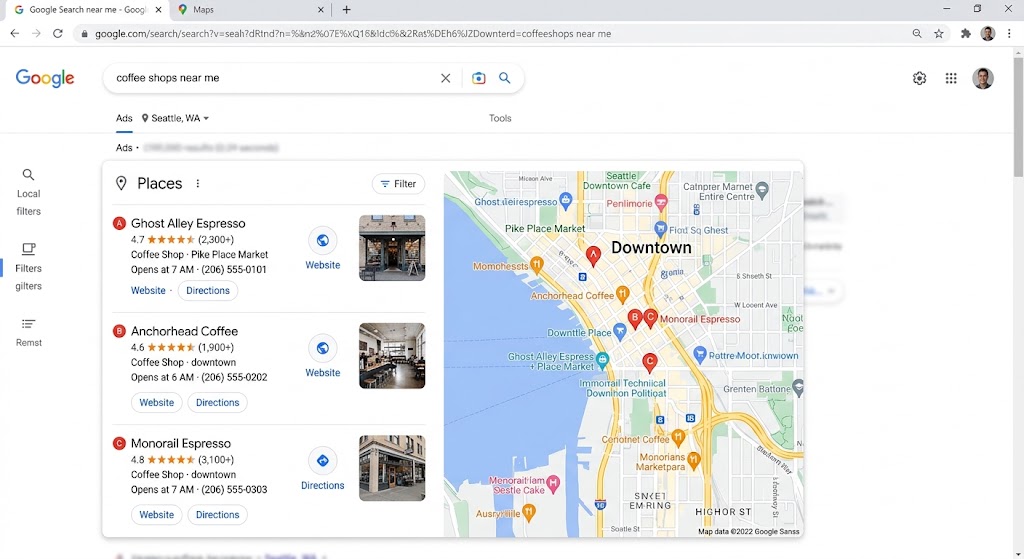
The Google Map Pack also called the Local Pack or 3-Pack is the block of three local business listings that appears near the top of Google search results for local queries. It sits alongside a small map with location pins.
Each listing shows the business name, star rating, review count, and quick action buttons like call, directions, and website. When someone searches “electrician near me” or “dentist in Austin,” the Map Pack is often the first thing they see and the first thing they click.
The Map Pack pulls its data from Google Business Profiles, websites, reviews, and directory citations across the web. It is separate from the standard blue-link organic results below it. Ranking in one does not guarantee ranking in the other.
If you want a deeper breakdown of how this feature functions, read our full guide on What Is the Google Map Pack and How Does It Actually Work.
Can You Rank in the Google Map Pack in 30 Days?
The honest answer is: it depends on where you start and who you are competing against. Below are three common scenarios and what 30 days realistically looks like for each.
Scenario 1: You Are Already Ranking (Positions 4–10)
If your business already shows up on the first page of local results but sits just outside the top 3, 30 days is often enough to break through. Your profile already has trust with Google. The work here is refinement — better categories, more reviews, tighter website relevance, and consistent citations. Movement into the Map Pack within a month is a realistic goal for this group.
Scenario 2: You Have a Weak Existing Profile
If your profile is verified but incomplete — wrong category, no services listed, few reviews, thin website — 30 days will produce visible improvement, but a top-3 spot is less certain. You will likely climb several positions and may enter the Map Pack for lower-competition, long-tail keywords first. The main city keyword may take longer.
Scenario 3: You Are a New Business in a Competitive Market
A brand-new profile in a crowded niche (think legal, dental, or plumbing in a large city) faces the steepest climb. Google is cautious with new listings and needs time to build trust. In 30 days, expect to lay a strong foundation and start ranking for easier keywords. Competitive city terms usually require three months or more of steady work.
Whatever your scenario, the plan below moves you forward. Just match your expectations to your starting point.
How Google Determines Local Rankings
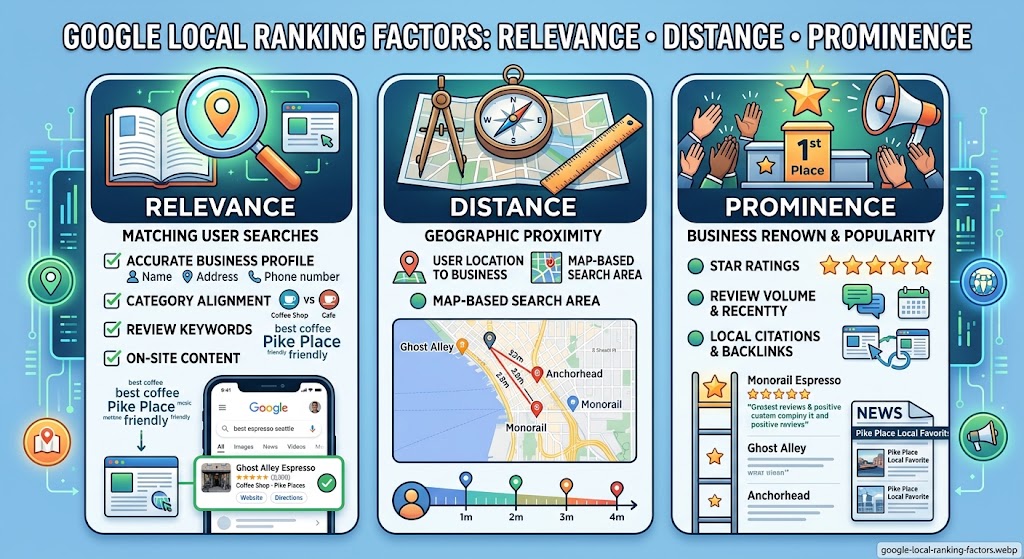
Google has described local ranking as a function of three factors for well over a decade. Understanding them is the key to any 30-day plan, because every task you complete should strengthen at least one.
Relevance
Relevance is how well your business matches what someone searches for. Your primary category carries the single largest relevance signal, followed by your services list, business description, and the content on your website. A plumber whose primary category is “Plumber” will out-relevance one listed as “Contractor” for plumbing searches.
Distance
Distance is how close your business is to the person searching. For storefronts, Google measures from your physical address. For service-area businesses, it measures from your registered base location — not from the service areas you list. You cannot fake proximity by adding more cities.
Prominence
Prominence is how well-known and trusted your business is, both online and offline. It is built through review count, review velocity, review sentiment, backlinks, and consistent business information across directories. Prominence is where most of your 30-day effort will pay off, because it is the factor you can influence fastest.
You can read Google’s own explanation in Google’s official guidance on improving local ranking. Everything in this guide maps back to these three pillars.
Before You Start: Check Where You Rank Now
You cannot measure improvement without a baseline. Before you touch anything, record where you currently rank for your target keywords.
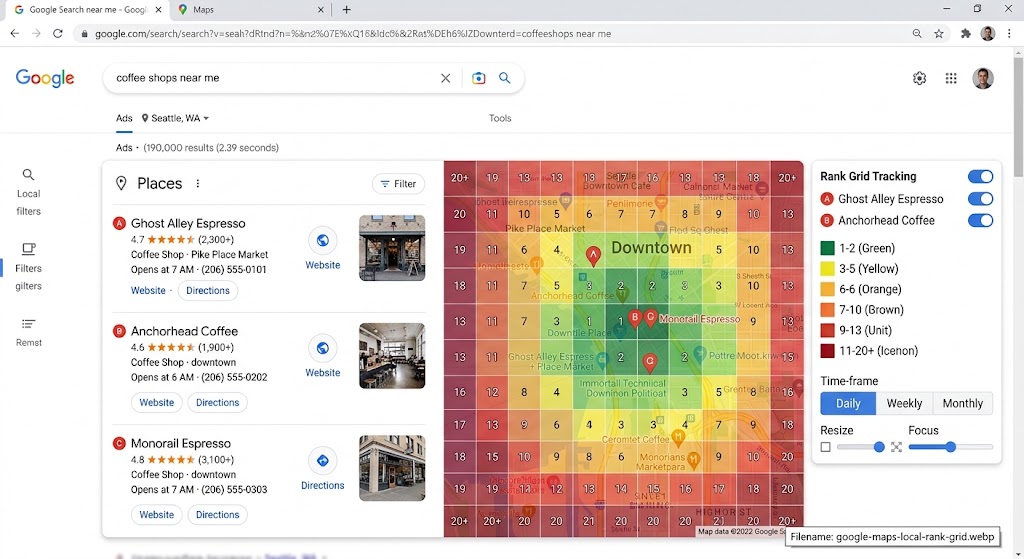
Do not just search from your office and assume that is your ranking. Google personalizes results based on your location and search history. Instead, use a local rank grid tool (like Local Falcon or BrightLocal) that checks your position from multiple points across your service area. This shows you the truth: you might rank #2 near your address and #25 three miles away.
Write down your top 5 target keywords and your grid position for each. This is your day-zero snapshot. In 30 days, you will compare against it.
30 Day Google Map Pack Ranking Plan
This roadmap breaks the month into six focused phases. Each phase builds on the last. Do not skip ahead — fixing prominence before you fix relevance is like adding fuel to a car with no engine.

Days 1 to 3: Audit and Diagnose
Start by reviewing your entire Google Business Profile with fresh eyes. Confirm your profile is verified. Check your business type storefront, service-area, or hybrid and make sure it matches how customers actually reach you. A mismatch here is one of the most common causes of poor visibility.
Note every gap: missing services, an empty description, a weak category, thin photos, or unanswered reviews. Also pull up your top three competitors in the Map Pack and note their primary categories, review counts, and how complete their profiles look. This tells you what “good” looks like in your market.
If your business type is unclear, review the difference between a Service Area vs Storefront Business on Google Business Profile before making changes. The wrong setup can cap your rankings or trigger a suspension.
Days 4 to 7: Fix the Google Business Profile
Now correct everything the audit flagged. Set your primary category to the most specific accurate description of your core service. Add relevant secondary categories. Fully populate your services list with individual service names and short descriptions.
Write a clear business description that names your main service and city, but reads naturally. Add accurate hours, attributes, and a full set of high-quality photos exterior, interior, team, and work samples. Make sure your Name, Address, and Phone number exactly match what appears on your website.
This phase is about completeness. A fully built profile sends Google a strong relevance signal and gives customers fewer reasons to click a competitor.
Days 8 to 14: Build Relevance
With the profile fixed, deepen your relevance signals. Add or improve service-specific content on your website. If you serve multiple cities, each key location should have its own page with unique content — not the same paragraph with the city name swapped in.
Populate your profile’s Q&A section with the real questions customers ask, and answer them clearly. Publish a few Google Business Profile posts about your services. Every piece of content should reinforce what you do and where you do it.
Days 15 to 21: Strengthen Prominence
This is where reviews and citations do the heavy lifting. Start a simple, consistent review request process — ask every satisfied customer, and make it easy with a direct review link. Aim for a steady trickle rather than a sudden flood, which can look unnatural.
Reply to every review, old and new. Build or clean up your local citations so your NAP is identical across Yelp, Bing Places, Apple Maps, and industry directories. Inconsistent listings confuse Google and erode trust. This phase often produces the most visible ranking movement.
Days 22 to 26: Improve Conversion and Profile Engagement
Rankings and clicks are not the same thing. A listing that ranks but does not convert wastes the visibility you earned. Sharpen the elements that turn views into calls: a compelling description, standout photos, complete service info, and recent posts.
Profile engagement calls, direction requests, website clicks, and photo views also feeds back into prominence. The more people interact with your listing, the more Google trusts that it deserves its position. Add a booking link or highlight your strongest reviews to nudge action.
Days 27 to 30: Measure, Compare and Refine
Return to your day-zero grid snapshot and run the same rank check. Compare positions across every grid point, not just from your office. Look for patterns: which keywords moved, which stayed flat, and where geographically you gained ground.
Use what you learn to plan the next 30 days. Local SEO is ongoing, not a one-time fix. If a keyword barely moved, it likely needs more relevance or prominence work. Steady, consistent effort compounds over the following months.
The 10 Most Important Map Pack Optimization Areas
If you focus your 30 days on anything, focus here. These ten areas drive the majority of local ranking results.
- Correct Primary Category. Your single most important relevance signal. Choose the most specific category that describes what your business fundamentally is.
- Strong Secondary Categories. Add categories for your other core services, but avoid stuffing in loosely related ones.
- Complete Services. List every service individually with a short, clear description. Empty service sections leave relevance on the table.
- Accurate Business Information. Your NAP, hours, and attributes must be correct and consistent everywhere online.
- Genuine Reviews. Real reviews from real customers, gathered steadily over time. Never buy or fake them.
- Website Local Relevance. Your site should clearly state your services and locations, with dedicated pages for key service areas.
- Local Citations. Consistent listings across major and niche directories reinforce your legitimacy.
- Local Authority. Backlinks from local news, community groups, and industry sites raise your prominence.
- Geographic Relevance. Configure your service areas and address setup correctly. For help, see How to Add Multiple Service Areas to a Google Business Profile Correctly.
- Competitor Analysis. Study who ranks above you and reverse-engineer the gaps between their profile and yours.
Does Distance Matter for Google Map Pack Rankings?
Yes — distance is one of Google’s three core ranking factors, and you cannot ignore it. For storefronts, Google measures the distance between the searcher and your physical address. Businesses closer to the searcher get a proximity advantage.
For service-area businesses, Google calculates distance from your registered base location, not from the list of cities you serve. This surprises many owners. Adding 20 cities to your profile does not extend your ranking reach it only tells Google where you claim to operate.
You cannot change your physical location in 30 days. What you can do is compete on the two factors you control: relevance and prominence. A business with outstanding reviews and a fully optimized profile can outrank a closer competitor with a weak, neglected listing.
Can Reviews Help You Reach the Map Pack Faster?
Reviews are one of the fastest prominence levers you can pull in 30 days. They influence both your ranking and whether searchers actually choose your listing.
Three things matter: quantity (how many reviews you have), velocity (how consistently new ones arrive), and sentiment (how positive they are). A steady stream of two to five genuine reviews per week signals an active, trusted business. A sudden dump of 30 reviews in one day looks suspicious and can backfire.
Replying to every review — thanking happy customers and professionally addressing complaints — signals engagement to both Google and future customers. Never buy reviews or write fake ones. Google’s systems catch this, and the penalties are far worse than slow growth.
Do Citations Still Matter for Map Pack Rankings?
Yes, citations still matter, though their role has shifted. A citation is any online mention of your business name, address, and phone number — on Yelp, Bing Places, Apple Maps, and industry-specific directories.
Citations no longer work as a raw numbers game. Blasting your business across hundreds of low-quality directories adds little. What matters is consistency. When your NAP is identical everywhere, Google’s confidence in your data rises. When it is inconsistent — a suite number here, an old phone number there trust drops and rankings can follow.
In 30 days, prioritize accuracy over volume. Claim and correct your listings on the major platforms and the top directories for your niche. That consistency supports the prominence you are building through reviews.
Does Website SEO Affect Google Maps Rankings?
Yes. Your website and your Google Business Profile are connected, and a strong website pushes your Map Pack rankings harder. Google looks at your site to confirm relevance — what you do and where you do it.
A site that clearly states “HVAC repair in Denver,” includes location pages for each service area, and loads quickly on mobile reinforces your profile’s signals. A thin or slow site that never mentions your city gives Google less to work with. Embedding your Google Map on a contact page and keeping your NAP in the footer also helps tie the two together.
You do not need a website to rank a service-area business, but in competitive niches, one gives you a real edge. Choose this route if your competitors have strong sites and you are fighting for a crowded keyword.
Do Google Business Profile Posts Help You Rank Faster?
Google Business Profile posts have a modest, indirect effect on rankings. They are not a magic switch, but they support your broader efforts in two ways.
First, posts add fresh, keyword-relevant content to your profile, which reinforces relevance. Second, they keep your listing active and give searchers a reason to engage — and engagement feeds prominence. A profile that posts weekly looks alive; one that has not posted in years looks dormant.
Use posts to highlight services, promotions, and answers to common questions. Treat them as a consistency habit during your 30 days, not as the main driver of rankings.
What NOT to Do If You Want Faster Map Pack Rankings
Speed tempts people into shortcuts that get profiles suspended. Avoid these entirely:
- Keyword stuffing your business name. Naming your business “Best Cheap Plumber Chicago” instead of your real name is the fastest route to a suspension.
- Buying or faking reviews. Google detects unnatural review patterns, and the penalty erases far more progress than the reviews ever gained.
- Using a virtual office or PO Box as your address. Google explicitly prohibits this, and recovery from the resulting suspension is slow and painful.
- Creating duplicate listings for the same business to grab more exposure. Google merges or removes them.
- Adding cities you do not serve to inflate your service area. This dilutes relevance rather than expanding reach.
Aggressive optimization and rule-breaking are not the same thing. The plan in this guide is aggressive but stays fully inside Google’s guidelines.
What If You Are Not Ranking After 30 Days?
If the Map Pack still eludes you after a month, do not panic — and do not conclude the work failed. First, recheck your grid data. You may have gained real ground for long-tail keywords even if the main city term hasn’t moved. Progress often shows up on the edges first.
Next, diagnose the likely cause. Common culprits include an unverified profile, a business-type misconfiguration, a soft suspension, NAP inconsistencies, or simply a very competitive market that needs more time. Our guide on why your Business Not Showing on Google Maps? 8 Expert Fixes & Reasons walks through each one.
In competitive niches, three to six months of steady work is the realistic timeline for top-3 placement on the toughest keywords. Thirty days builds the foundation. The following months build the authority that holds a top spot long-term. Keep gathering reviews, keep your citations clean, and keep your profile active.
30 Day Map Pack Ranking Checklist
Use this to track your progress through the month:
Foundation (Days 1–7)
- Profile is verified
- Business type matches how customers reach you
- Primary category is the most specific accurate option
- Secondary categories added for core services
- Services list fully populated with descriptions
- Business description written naturally with service and city
- NAP matches website exactly
- 10+ quality photos uploaded
Relevance (Days 8–14)
- Service-specific website content added or improved
- Dedicated location pages for key service areas
- Q&A section populated and answered
- Google Business Profile posts published
Prominence (Days 15–21)
- Consistent review request process in place
- Every review has a reply
- Citations claimed and NAP made consistent across directories
Conversion & Measurement (Days 22–30)
- Description, photos, and posts optimized for clicks
- Booking or call actions highlighted
- Day-zero grid snapshot recorded
- Day-30 grid check compared against baseline
- Next 30-day priorities identified
Frequently Asked Questions
How long does it really take to rank in the Google Map Pack?
It ranges from a few weeks to several months. Businesses already sitting in positions 4–10, or those targeting low-competition long-tail keywords, can enter the Map Pack within 30 days. New businesses in competitive city markets typically need three to six months of steady work for top-3 placement.
Can you guarantee a top 3 Map Pack position in 30 days?
No, and you should be wary of anyone who does. Google’s ranking system weighs Relevance, Distance, and Prominence, and factors like proximity and competition are outside your control. A 30-day plan is an aggressive optimization roadmap, not a guaranteed formula.
Do I need a website to rank in the Google Map Pack?
Not necessarily. Service-area businesses can rank with a strong, well-optimized Google Business Profile alone. However, a fast, location-rich website strengthens your relevance signals and gives you a real advantage in competitive niches.
How many reviews do I need to rank in the Map Pack?
There is no fixed number. What matters is having more genuine, positive reviews than the competitors you are trying to outrank, plus a steady flow of new ones. Check the review counts of the current Map Pack for your keyword to gauge your target.
Will adding more service areas help me rank in more cities?
No. For service-area businesses, Google calculates proximity from your registered base location, not from the cities you list. Adding areas you do not genuinely serve dilutes your relevance. City-specific rankings come from local content, reviews, and citations — not from checking a box.
What is the single most important factor for Map Pack rankings?
There is no one factor, but your primary category is the strongest single relevance signal, and reviews are the fastest prominence lever you can influence. Get both right and you address two of Google’s three ranking pillars.

Arbaz Shaukat is a Local SEO Expert who helps websites generate more leads, traffic, and sales from Google and AI-driven search platforms like ChatGPT through proven SEO strategies. He is the Founder of GBP Optimization Services, where he works closely with businesses to improve their online visibility on the internet.
Since 2020, Arbaz has been active in SEO and loves to share experience-based blog content offering practical insights, tested SEO techniques, and real-world strategies that help businesses grow and compete effectively online.