Google Business Profile Attributes : Which Ones Actually Impact Rankings?
While Google Business Profile attributes can improve user experience and relevance, most of them are not considered direct local ranking factors.
That’s because most advice about GBP attributes gets one big thing wrong. It treats every attribute like a ranking booster. The truth is more useful, and a lot more practical.
This guide breaks down exactly which attributes affect rankings, which ones drive clicks, and which ones help AI tools recommend your business. No fluff. Just what works in real campaigns.
Do GBP Attributes Affect Rankings?
Most Google Business Profile attributes do not directly affect rankings. They mainly improve relevance matching, power Maps filters, build trust, and feed AI search summaries.
Here’s the short version:
- Some attributes help Google match you to specific searches.
- Most attributes are not direct ranking factors.
- Certain attributes help Google understand your business traits.
- Others mainly boost conversions and clicks.
Your primary category and reviews carry far more ranking weight than any attribute. Attributes still matter. They just matter for the right reasons.
What Are Google Business Profile Attributes?
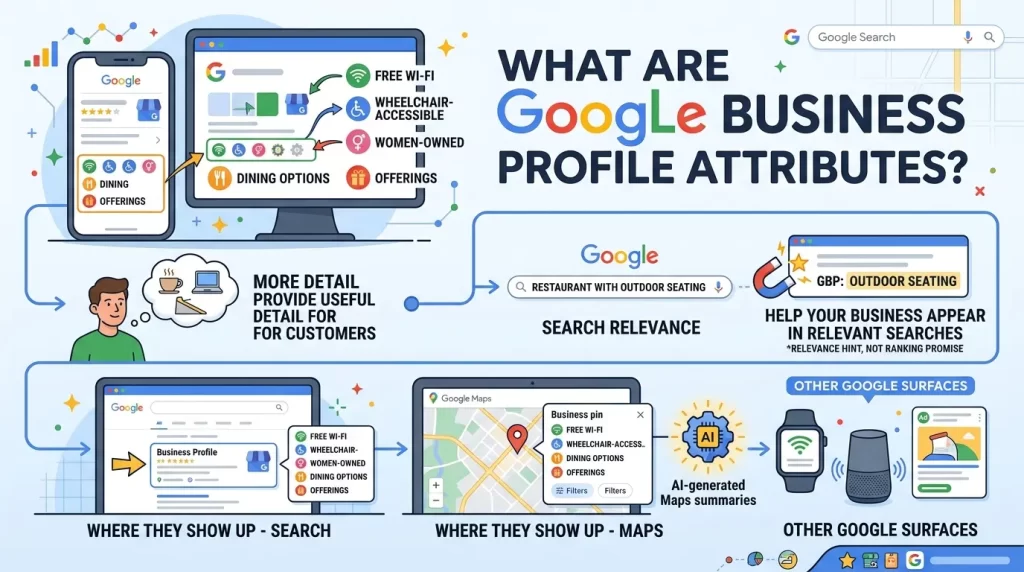
GBP attributes are small details that describe what your business offers. Think “free Wi-Fi,” “wheelchair-accessible entrance,” or “women-owned.”
Google’s own help docs say attributes show up on your profile across Search and Maps. Their job is to give customers more useful detail about you.
Google also notes that adding certain attributes may help your business appear in searches for places with those features. That’s a relevance hint, not a ranking promise.
Before optimizing attributes, make sure your profile is built on the right foundation because your Google Business Profile primary category carries significantly more ranking weight than any attribute.
Where attributes appear:
- Your profile on Google Search
- Google Maps listings and filters
- AI-generated Maps summaries
- Other Google surfaces
How are attributes different from categories?
Categories tell Google what your business is. Attributes tell Google what your business offers.
A “Mexican Restaurant” is a category. “Outdoor seating” and “serves vegetarian food” are attributes.
While attributes can improve relevance and customer engagement, businesses that want stronger local visibility often benefit from professional Google Business Profile optimization services that focus on the ranking factors that matter most.
How Google Uses Attributes Inside Business Profiles
Attributes do five clear jobs. None of them is “boost your Maps rank directly.”
- Business understanding: They help Google grasp what you offer.
- User experience: They answer common customer questions upfront.
- Relevance matching: They connect you to specific search needs.
- Search filtering: They let users filter Maps by feature.
- Entity classification: They feed Google’s view of your business as an entity.
The Truth About Attributes and Google Maps Rankings
Let’s clear up the confusion. Attributes touch several signal types, and only some relate to rankings at all.
| Signal type | What it does | Direct ranking impact? |
|---|---|---|
| Ranking signal | Moves your Local Pack position | Very limited |
| Relevance signal | Matches you to specific queries | Indirect |
| Conversion signal | Drives calls, clicks, and visits | Indirect |
| Trust signal | Builds confidence and credibility | Indirect |
| CTR signal | Improves click-through rate | Indirect |
| AI signal | Feeds AI summaries and answers | Indirect |
Google describes local ranking with three factors: proximity, relevance, and prominence. Attributes touch relevance lightly. They don’t move proximity or prominence in any real way.
GBP Attributes That May Improve Local Search Relevance
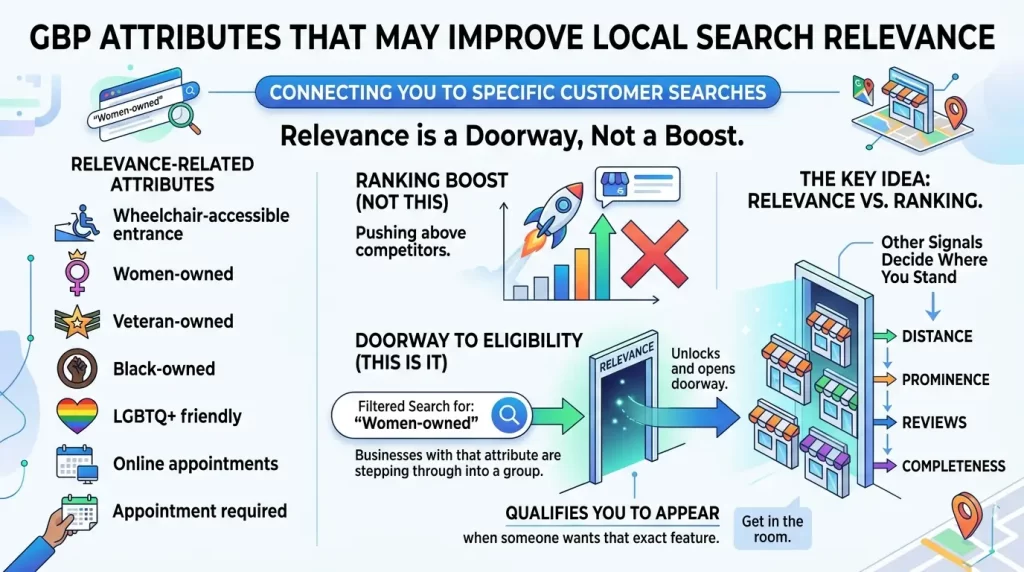
Some attributes connect you to specific searches. When someone filters Maps or asks for a feature you’ve listed, you become eligible to appear.
Relevance-related attributes:
- Wheelchair-accessible entrance
- Women-owned
- Veteran-owned
- Black-owned
- LGBTQ+ friendly
- Online appointments
- Appointment required
Here’s the key idea: relevance is not the same as ranking.
Being eligible for a filtered search doesn’t push you above competitors. It simply qualifies you to appear when someone wants that exact feature.
Think of it as a doorway, not a boost. You get in the room. Other signals decide where you stand inside it.
Attributes That Mostly Influence Click-Through Rate and Conversions
Many GBP attributes never touch rankings at all. Instead, they make people more likely to choose you.
Conversion-focused attributes:
- Free Wi-Fi
- Free parking
- Curbside pickup
- Delivery
- Outdoor seating
- Same-day service
When a hungry customer spots “outdoor seating” and “delivery,” they’re more likely to tap your listing. That click matters more than people think.
How can clicks indirectly affect visibility?
Google watches how people interact with your listing. Calls, clicks, and direction requests act as behavioral signals.
These real-world actions carry weight. A profile with strong engagement often outperforms a passive one over time.
Attributes vs Categories: Which Carries More Ranking Weight?
This one isn’t close. Your primary category is the single biggest on-profile ranking lever you control.
| Factor | Ranking weight | Why it matters |
|---|---|---|
| Primary category | Very high | Defines your competitive set and core relevance |
| Additional categories | Moderate | Expands the queries you can show up for |
| Attributes | Low | Refines details and powers Maps filters |
Switching a profile from “Law Firm” to “Personal Injury Attorney” can shift Maps visibility more than any attribute edit ever will.
So pick the narrowest accurate category first. Then add attributes to round out the picture.
How Attributes Help Google Understand Business Entities
Google doesn’t just read your profile. It builds an entity around your business. Attributes feed that process.
In the Knowledge Graph, attributes describe the properties of an entity. They also help Google link your business to related concepts.
What attributes contribute:
- Entity classification: Grouping your business by shared traits.
- Knowledge Graph connections: Linking you to related entities and topics.
- Business characteristics: Defining what makes you distinct.
- Semantic relevance: Matching your details to the meaning behind a search.
Why does this matter? Accurate Google attributes help the system trust and classify you correctly. The closer your details match how people search, the more relevant you become.
Sloppy or contradictory attributes do the opposite. They blur the entity and weaken Google’s confidence in your data.
How Attributes Influence Google AI Overviews and AI Search Engines
This is where attributes matter more than ever. AI summaries now sit above the classic Maps panel in many searches.
These summaries pull from reviews, posts, web content, and your structured profile data, including attributes.
Ask a conversational query like “wheelchair accessible dentist near me.” Google feeds your accessibility attributes straight into the answer. Thin profiles get weaker summaries. Detailed ones get cited.
How attributes support AI visibility:
- Structured business data: Gives AI clean facts to build on.
- Recommendation systems: Helps AI match you to specific needs.
- Entity understanding: Reinforces who and what you are.
- Trust indicators: Consistent, accurate data earns mentions.
Consistent and accurate profile attributes don’t just support local visibility; they also contribute to the entity signals and structured data that influence how to rank in AI search engines such as ChatGPT, Gemini, Claude, and Perplexity.
Which GBP Attributes Matter Most by Industry?
Not every attribute fits every business. Here’s where to focus by type.
Restaurants:
- Outdoor seating, delivery, takeout, reservations, serves vegetarian food, dietary options
Law Firms:
- Online appointments, appointment required, wheelchair accessibility, identity attributes (veteran-owned, women-owned)
Medical Practices:
- Wheelchair-accessible entrance and restroom, accessible parking, online appointments, assistive listening devices
Home Services:
- Online estimates, on-site services, language options, identity attributes
Local Contractors:
- Service-area coverage, online estimates, appointment required, payment options
Retail Businesses:
- Curbside pickup, in-store shopping, delivery, wheelchair accessibility, recycling options
Choose the local business attributes your customers actually search for. Skip the rest. More is not better here.
Common GBP Attribute Mistakes
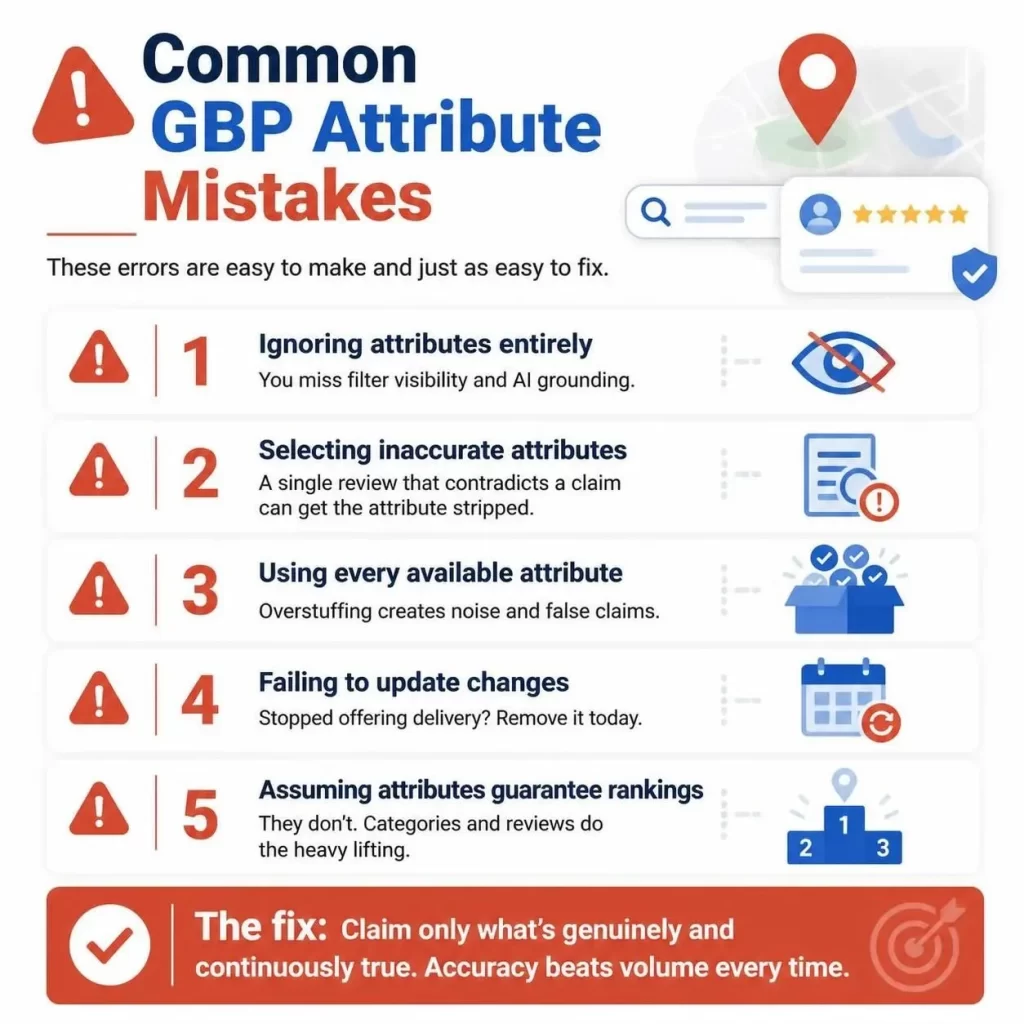
These errors are easy to make and just as easy to fix.
- Ignoring attributes entirely. You miss filter visibility and AI grounding.
- Selecting inaccurate attributes. A single review that contradicts a claim can get the attribute stripped.
- Using every available attribute. Overstuffing creates noise and false claims.
- Failing to update changes. Stopped offering delivery? Remove it today.
- Assuming attributes guarantee rankings. They don’t. Categories and reviews do the heavy lifting.
GBP Attribute Testing Framework
Want proof of what works for your business? Run a controlled test. Isolate one change and measure it. This is the same approach I use across client campaigns.
- Baseline measurement. Record current rankings and listing actions before any change. Screenshot your Performance data.
- Attribute updates. Add or edit a single attribute. Change one thing at a time.
- Tracking visibility. Wait at least 48 hours. Then check filtered and conversational searches for movement.
- Monitoring conversions. Watch calls, clicks, and direction requests in your Performance tab.
- Evaluating results. Did relevance or engagement improve? Keep it. If nothing changed, move to a higher-impact factor.
This method shows you cause and effect instead of guesswork. It also protects you from chasing tips that don’t apply to your market.
The GBP Attribute Audit Checklist
Run through this list every quarter. You can act on it right now.
- Primary category is the narrowest accurate option
- Accessibility attributes are accurate and current
- Identity attributes reflect genuine ownership
- Service detail attributes (Wi-Fi, parking, delivery) are true today
- No recent reviews contradict your attribute claims
- Attributes match what your customers actually search for
- Outdated or discontinued attributes are removed
- Attribute data is consistent with your website and citations
What Actually Matters More Than Attributes?
If your time is limited, spend it here first. These factors carry the real ranking weight.
- Categories: Your strongest on-profile relevance signal.
- Reviews: Quantity, recency, and steady flow drive prominence.
- Website relevance: Hyperlocal content and clear service descriptions.
- Service pages: A dedicated page for each service is a top-tier factor.
- GBP optimization: Complete profile, accurate hours, fresh photos.
- Local citations: Consistent name, address, and phone across directories.
- Behavioral signals: Calls, clicks, and direction requests from real users.
Fix these before you obsess over profile attributes. They move the needle far more than any feature checkbox.
FAQs
Do attributes directly affect rankings?
No. Attributes are not confirmed direct ranking factors. They influence relevance, filtering, trust, and AI visibility. Your primary category and reviews carry the real ranking weight.
Which GBP attributes matter most?
The ones your customers actually search for. Accessibility attributes, identity attributes, and high-demand service details (like delivery or online appointments) tend to matter most, depending on your industry.
Can attributes improve Google Maps visibility?
Yes, indirectly. Attributes make you eligible for filtered searches and conversational AI queries. They can also lift clicks, which feeds the behavioral signals Google rewards.
Should I select every available attribute?
No. Only claim attributes that are genuinely and continuously true. Inaccurate ones can be removed and may hurt trust if reviews contradict them.
How often should attributes be reviewed?
Audit them quarterly, or any time your offerings change. Outdated attributes confuse both customers and AI engines.
Conclusion
Attributes help Google understand your business and can improve trust and visibility. But they don’t directly boost rankings.
For better results, focus on:
- The right primary category
- Recent reviews
- Strong service pages
- Consistent business information
Then use accurate attributes to strengthen your profile.
Need help? Contact us to improve your local visibility and rankings.

Arbaz Shaukat is a Local SEO Expert who helps websites generate more leads, traffic, and sales from Google and AI-driven search platforms like ChatGPT through proven SEO strategies. He is the Founder of GBP Optimization Services, where he works closely with businesses to improve their online visibility on the internet.
Since 2020, Arbaz has been active in SEO and loves to share experience-based blog content offering practical insights, tested SEO techniques, and real-world strategies that help businesses grow and compete effectively online.